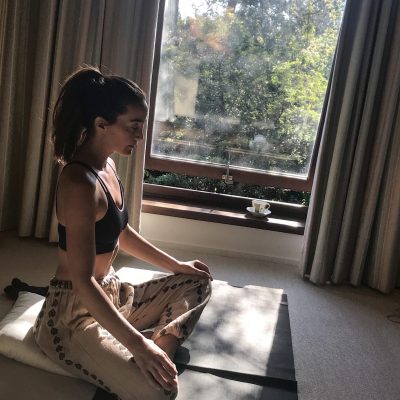
This is exactly why I wrote my free ebook. Learn to hear the difference between fear and true intuition, so you can trust yourself again.
Learn to distinguish between your soul’s wisdom and your mind’s worry
“Should I take this job?”
“Is this relationship right for me?”
“Should I move across the country?”
You close your eyes. You try to listen. And you hear… something. A voice. A feeling. A pull in one direction.
But here’s the question that keeps you frozen:
Is this my intuition guiding me… or just my fear trying to keep me safe?
If you’ve ever asked yourself this question, you’re not alone. This is the #1 thing people ask me as a meditation teacher and spiritual guide: “How do I know if I can trust what I’m hearing?”
Because here’s the truth: both intuition and fear speak to you. Both feel real. Both seem convincing. And sometimes, they’re saying completely opposite things.
I know what it’s like to feel disconnected from your inner wisdom—caught in the noise of daily life, second-guessing your intuition, wondering if that whisper inside is real or just wishful thinking.
For years, I’ve guided seekers back to their soul’s voice through meditation, journaling, and sacred ritual. I’ve witnessed the profound shift that happens when someone learns to distinguish between mental chatter and soul wisdom—it changes everything.
Today, I’m going to teach you exactly how to tell the difference.
By the end of this post, you’ll have five concrete tests you can use right now to know whether that voice in your head is your soul’s guidance or your fear’s protection. And more importantly, you’ll finally be able to trust yourself again.
Let’s begin.

Before we can distinguish intuition from fear, we need to understand what we’re listening for.
Your intuition isn’t some mystical gift reserved only for the chosen few. It’s the natural language of your soul, available to every single person at every moment of every day. This wise voice has been with you since birth, guiding you toward your true soul mission on this Earth.
Your intuition is your soul’s way of communicating with your conscious mind. It’s that quiet inner knowing that arrives without logical explanation. It’s the feeling in your body when something is right or wrong. It’s the sudden clarity that appears when you stop trying to figure everything out with your mind alone.
You’ve experienced this more times than you realize:
That’s your intuition. It’s always been there. You just need to learn to recognize its voice among all the noise.
But fear? Fear speaks in a very different language.

Here’s what makes this so confusing: fear is also trying to protect you.
Your fear isn’t the enemy. It’s an ancient survival mechanism designed to keep you safe from danger. When our ancestors heard rustling in the bushes, fear said “RUN!” and kept them alive.
The problem is, your fear can’t tell the difference between a genuine threat and an opportunity for growth that feels scary.
So it treats everything unfamiliar as dangerous:
Fear sounds so much like intuition because both arrive as strong feelings and urgent messages. Both make you feel something intensely. Both demand your attention.
The difference is in the quality of the message and the feeling it creates in your body.
Let me show you exactly how to tell them apart.
This free ebook includes a guided meditation to help you hear your intuition clearly.
These aren’t complicated spiritual practices. These are simple, practical tests you can use right now, in this moment, with whatever decision you’re facing.
This is the most reliable test I know.
Close your eyes. Think about the choice in front of you.
Now pay attention to what happens in your body:
Your turn:
Think about your decision. Close your eyes. Notice: expansion or contraction? Your body knows the answer before your mind figures it out.
An example from my life:
When I decided to leave my corporate job to become a writer, logic screamed that I was making a terrible mistake. But when I closed my eyes and imagined myself writing full-time, my whole body opened. I could breathe deeper. My shoulders dropped. My heart felt spacious.
When I imagined staying in that job for another year, my chest constricted. My breath got tight. My body literally tried to make itself smaller.
That’s how I knew.

Fear operates from scarcity and panic.
Intuition operates from trust and spaciousness.
Ask yourself:
Does this voice feel rushed and panicked, or grounded and certain? Your soul doesn’t need to convince you with urgency.
This is a big one.
Fear uses your insecurities against you. It speaks in the voice of your worst inner critic, reminding you of every past failure and every reason you’re not ready.
Intuition might tell you something isn’t right for you, but it does so with gentle redirection, not harsh judgment.
The tone matters.
If the voice sounds like someone who loves you deeply, that’s your soul. If it sounds like a bully trying to keep you small, that’s fear.
Notice: What’s the emotional quality of the voice you’re hearing? Loving guidance or harsh criticism?

This is subtle but profound.
It’s the same voice you use to plan your grocery list or worry about your to-do list. It feels like you spinning in circles, trying to figure things out.
“Well, if I consider all the factors, weigh the pros and cons, analyze the data…”
It often arrives as a sudden knowing that appears fully formed, wisdom that surprises you with its clarity, insight that feels wiser than your usual thinking.
“I just know this is what I need to do.”
Ask yourself:
Does this feel like your usual mental chatter? Or does it feel like wisdom arriving from a deeper place within you?
This is the ultimate truth test.
Imagine yourself actually doing what the voice is telling you to do. Really visualize it. See yourself taking that action, making that choice, walking that path.
Now notice what your body does:
Your body never lies.
Try it now: Close your eyes. Visualize yourself following the guidance. What does your body do? Trust that response.
1. Does it expand or contract you?
2. Does it come with urgency or patience?
3. Does it criticize or guide you?
4. Does it feel like “you” or something wiser?
5. What does your body do when you imagine following it?
Want the complete guide to trusting your intuition?

A few years ago, I was offered an opportunity to co-author a book with someone I admired. On paper, it was perfect. Great exposure, established platform, guaranteed audience.
But something felt off.
I kept hearing a voice saying “Don’t do this.” But I couldn’t tell if it was:
So I ran it through the five tests:
Test 1 (Expand/Contract): When I imagined signing the contract, my chest got tight. When I imagined saying no, I could breathe again. Contraction = Fear disguised as opportunity.
Test 2 (Urgent/Patient): The other person was pushing me to decide quickly. My soul kept saying “Wait. You don’t need to rush.” Urgency came from outside pressure, not inner knowing.
Test 3 (Criticize/Guide): One voice said “You’ll never get another chance like this, you fool.” Another voice said “This isn’t aligned with your authentic message.” Criticism vs. loving redirection.
Test 4 (You/Wiser): The anxious thoughts were clearly my usual mental spinning. But underneath was a calm knowing: “This isn’t yours to write.” That deeper knowing was my soul.
Test 5 (Body Response): When I imagined co-writing, I felt drained. When I imagined writing alone, I felt energized. My body knew the truth.
I said no to the book deal. Two months later, I received an offer to write something completely different—something that became one of my most authentic and successful projects.
My intuition was protecting my true path, even when it looked like I was saying no to a “good opportunity.”
Fear would have kept me stuck in the wrong thing out of scarcity. Intuition gave me the courage to wait for what was actually mine.

Even with these five tests, sometimes you genuinely can’t tell.
And that’s okay.
Here’s what I do when I’m still confused after running through all the tests:
Your soul speaks most clearly when you’re connected to the earth. When you’re stuck in your head, analyzing and overthinking, the best thing you can do is get outside.
Walk barefoot on grass. Stand under trees. Sit by water. Feel the ground beneath your feet.
Nature has a way of cutting through mental noise and bringing you back to what’s true. Often, the clarity you couldn’t find in meditation arrives while walking in the forest or sitting by the ocean.
Why this works: When you’re physically grounded in nature, your energy field naturally recalibrates. The endless thinking stops. And in that quiet space, your soul’s voice becomes clear.
Try this: Go for a walk with your question held gently in your heart (not spinning in your head). Don’t try to figure it out. Just walk. Notice what arises.
If you can’t get outside, create a quiet sanctuary inside. Find a place where you won’t be disturbed. Light a candle. Take a few deep breaths. Place your hand on your heart.
Then ask out loud: “Soul, is this guidance from you? Or is this my fear speaking?”
Sit in silence and see what arises. Sometimes just asking the question directly creates enough space for clarity to emerge.
If it’s truly important guidance from your soul, it won’t go away. Real intuition is persistent without being frantic. It will keep showing up, gently, consistently, patiently.
Fear, on the other hand, often loses power when you don’t feed it with immediate reaction.
Give yourself permission to say: “I don’t know yet, and that’s okay. I’ll stay open and wait for clarity.”
The answer will come. Sometimes in meditation. Sometimes in nature. Sometimes in a dream. Sometimes while washing dishes. Trust that when you need to know, you will.
Write out the guidance you’re receiving. Then write out your response to these questions:
Sometimes seeing your thoughts on paper reveals the truth your mind couldn’t access. Your hand often knows what to write before your brain knows what to think.
Here’s what I’ve learned after years of teaching people to trust their intuition:
The more you practice distinguishing between intuition and fear, the easier it becomes.
It’s like learning a new language. At first, you have to consciously translate every word. Eventually, you think in the new language without effort.
Your intuition is a language. And meditation is the practice that helps you become fluent in it.
When you create sacred space daily to sit in silence, you strengthen your ability to hear your soul’s voice clearly. You learn its tone, its rhythm, its feeling. You build trust with yourself.
You don’t need hours. Even five minutes of daily stillness creates profound shifts.
Find a comfortable place to sit. Close your eyes. Place your hand on your heart. Take three slow breaths. And simply ask: “What does my soul want me to know today?”
Then listen. Not with your thinking mind, but with your feeling heart.
The more you practice this, the clearer your intuition becomes. And the easier it is to tell when fear is masquerading as guidance.

Let me tell you something important:
You haven’t been doing anything wrong. Your intuition hasn’t abandoned you. You’re not broken or disconnected or less spiritual than everyone else.
You’ve just been looking for your soul’s voice in a language you haven’t fully learned yet.
And that’s what this practice is about—learning to recognize the specific way your soul communicates with your conscious mind.
Some people receive intuition primarily through feeling in their body (that’s called clairsentience). Others hear an inner voice clearly (clairaudience). Some see images or symbols (clairvoyance). Others simply know without explanation (claircognizance).
There’s no “better” way. Your soul will use whatever language you can hear most clearly.
The practice of creating sacred space—through meditation, journaling, and intentional stillness—helps you become more receptive to all these channels. Gradually, you strengthen your ability to hear your soul in whatever way it chooses to speak.
And when you can finally distinguish between fear’s protection and soul’s guidance? Everything changes.
You make decisions with confidence, knowing they’re right for you even if they don’t make sense to anyone else.
You trust yourself deeply, even when others don’t understand your choices.
You feel aligned with your authentic path, like you’re finally walking in the right direction after years of wandering.
You navigate life’s challenges with inner wisdom as your guide, turning to your soul first instead of seeking answers everywhere else.
You experience a sense of peace that comes from living in integrity with your deepest truth.
This is what it means to come home to yourself.
These five tests will serve you well. But if you want to deepen this practice and strengthen your connection to your soul’s voice…
It includes sacred space creation, the four ways your soul speaks, a guided meditation, and journaling prompts that unlock your inner wisdom.
This is the practice I use daily. The practice that transformed everything.
Download Free Guide: “How to Hear Your Soul’s Voice” →
Your soul is always speaking. You just need to learn its language.
With love and deep belief in your inner wisdom,
Phoebe Garnsworthy
Author, Meditation Teacher & Energy Healer
Have you ever confused intuition with fear? What happened when you followed one or the other? Share